As artificial intelligence moves from assisting humans to actively making decisions on their behalf, the stakes shift dramatically. Across boardrooms, hospitals, financial systems, and government institutions, algorithms are no longer passive tools. They are becoming co-authors of reality, shaping who gets hired, who receives care, how money flows, and which risks are worth taking. Yet behind this rapid transformation lies a dangerous gap: most organizations are deploying AI faster than they can define who is responsible when it gets things wrong.
We begin inside a world where decisions are no longer exclusively human. Insurance systems reject claims without explanation. Corporate platforms optimize outcomes at scale, yet no one can fully trace how conclusions are reached.
AI now detects patterns humans cannot see, hidden correlations across thousands of variables that escape intuition entirely. In doing so, it reshapes how organizations define “knowledge” itself. But this advantage comes with a cost.
Corporate mission statements love abstract words like fairness, transparency, and trust, but translating human philosophy into cold, hard code is another matter entirely. This chapter provides practical frameworks for building genuine accountability architectures, defining exactly who must answer when a machine makes a costly mistake.
In a hyper-competitive market, human oversight takes time, and time is expensive. Leaders figure out how to maintain control over autonomous systems without sacrificing the machine-speed agility required to survive.
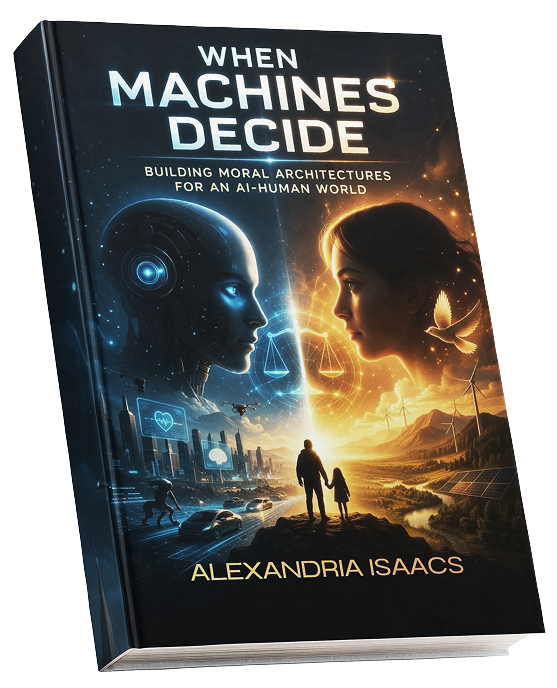
Most books about artificial intelligence either get tangled up in confusing tech jargon or float around in preachy philosophy. When Machines Decide is completely different. Alexandra Isaacs bridges that gap by offering a practical guide for today’s leaders. This book bypasses the usual sci-fi hype and scare tactics to give you a real, step-by-step playbook for the modern workplace. It proves that setting smart boundaries for technology is actually the best way to outsmart your competition.